
How to Search Kings County Court Records
Court records in Kings County are split across several official portals. There is no single Brooklyn docket site that holds every case type. The right tool depends on the court. For Civil Supreme Court matters, the public uses WebCivil Supreme. For e-filed cases, the official tool is NYSCEF. Criminal court dates are looked up through WebCriminal. Estate filings are searched on WebSurrogate. Each portal pulls from its own system and has its own field rules.
Before a search starts, gather what you know. An index number speeds civil lookups. A docket number speeds criminal lookups. A party name works if the case number is unknown. The Kings County Clerk's official page can be reviewed first for room and contact details. The Kings County Clerk's Office publishes the search and request guide.
The Kings County Clerk's office is the starting point for many in-person lookups. The image below links to the official Clerk page that lists rooms, hours, and contact lines.
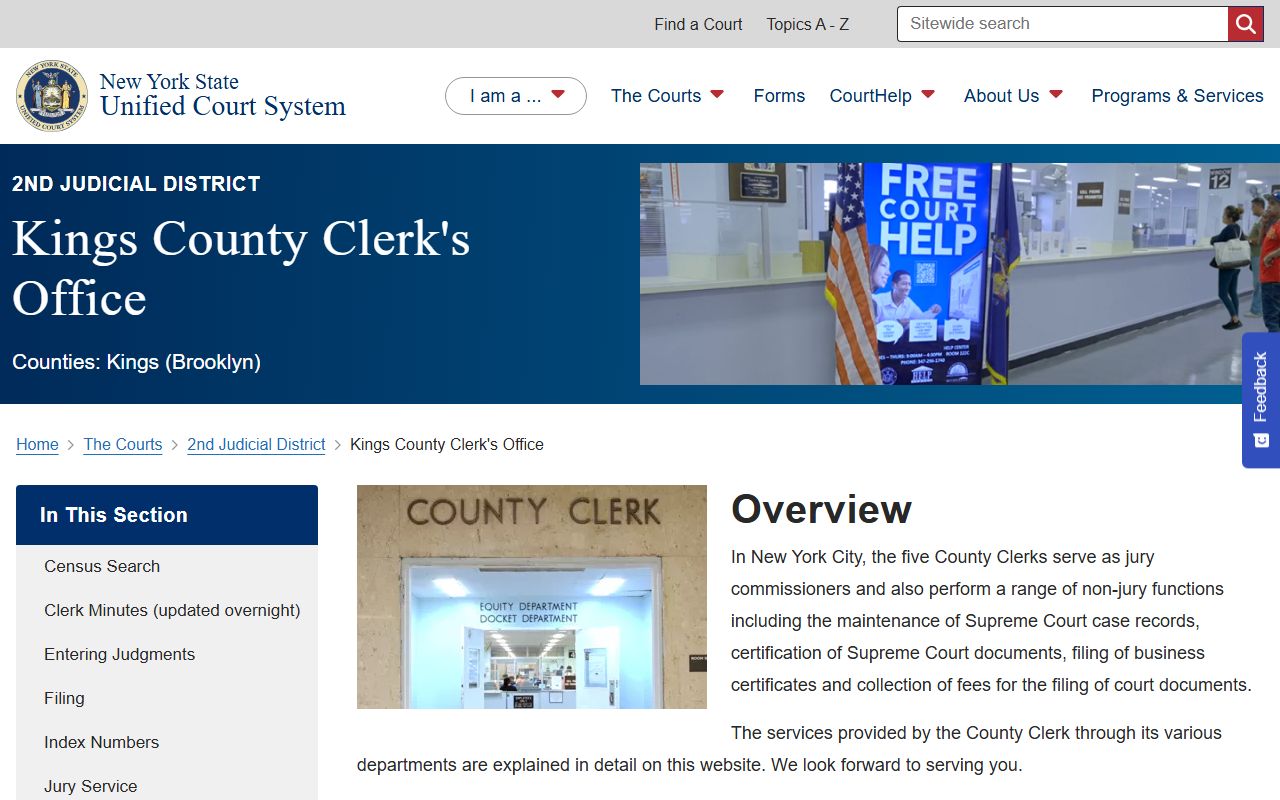
Use this listing to confirm the Clerk's Room 189 location at 360 Adams Street and the Record Room in Room 079 before traveling.
- Pick the right portal for the case type. Civil goes to WebCivil Supreme. Criminal dates go to WebCriminal. Estates go to WebSurrogate. E-filed matters appear in NYSCEF.
- Enter the index or docket number if known. The civil index format is NNNNNN/YYYY. The NYC Criminal Court docket format is CR-######-YYSU.
- If no number is known, switch to party-name search. WebCriminal needs at least the first three letters of the last name and first two letters of the first name.
- Limit the search to Kings County. The civil portal lets users Ctrl-click counties so the result list stays short and on point.
- Open the case to view docket entries, appearances, and any uploaded decisions or e-filed documents.
- For a certified copy, contact the Kings County Clerk at 360 Adams Street, Room 189, or the records room of the issuing court.
Note: WebCivil Supreme updates Kings County data four times each day, but sealed cases and Article 81 Mental Hygiene cases do not appear in the public results.
The Kings County Judicial System
New York court names confuse many first-time users. The Supreme Court is not the highest court in the state. It is the general trial court. In Kings County, the Supreme Court splits into a Civil Term at 360 Adams Street and a Criminal Term at 320 Jay Street. The highest court is the New York Court of Appeals. Appeals from Brooklyn flow through the Appellate Division, Second Judicial Department. Surrogate's Court holds the role that probate court holds in other states.
Lower courts in New York City also serve Kings County residents. The New York City Civil Court hears claims up to $50,000 along with Small Claims up to $10,000 and a Housing Part. The New York City Criminal Court handles misdemeanors and arraignments. The Family Court takes child support, custody, and child protective cases. This split matters for record requests because each court keeps its own file.
Case flow: NYC Civil/Criminal Court › Kings County Supreme Court › Appellate Division, Second Department › New York Court of Appeals
| Court | Jurisdiction | Case Types |
|---|---|---|
| Supreme Court, Civil Term | General civil trial court | Foreclosure, matrimonial, mental hygiene, name change, commercial |
| Supreme Court, Criminal Term | Felony trial court | Felony charges with sentences over one year |
| Surrogate's Court | Estate and adoption matters | Probate, administration, guardianship tied to estates, adoptions |
| Family Court | Family and child matters | Support, custody, visitation, abuse/neglect, juvenile delinquency |
| NYC Civil Court | Lower civil court | Civil claims to $50,000, small claims to $10,000, Housing Part |
| NYC Criminal Court | Lower criminal court | Misdemeanors, arraignments, preliminary felony hearings |
The Kings County Supreme Court Civil Term page describes Civil Term as the busiest civil bench in the state. Its image below links to the official Civil Term overview.
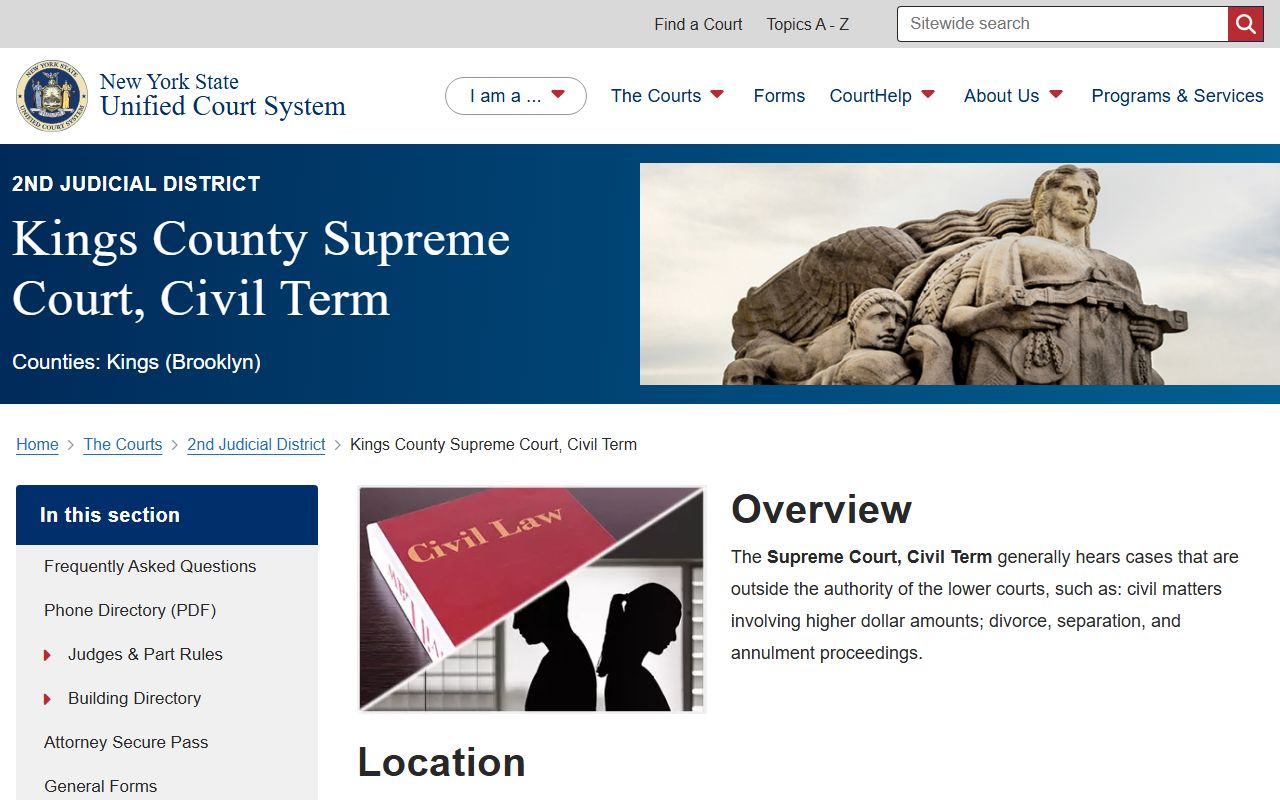
The same court keeps the Help Center in Room 123 for people without lawyers.
Kings County Courthouses
Brooklyn's main court buildings sit within a short walk of Borough Hall. A user can move on foot between Civil Supreme, Criminal Term, Family Court, and Surrogate's Court in the same downtown grid. Each address keeps its own clerk, its own records room, and its own hours.
Supreme Court, Civil Term & Kings County Clerk
360 Adams Street, Room 189
Brooklyn, NY 11201
347-296-1800
Mon-Fri 9 AM-5 PM
Supreme Court, Criminal Term
320 Jay Street
Brooklyn, NY 11201
347-296-1076
Mon-Fri 9 AM-5 PM
Kings County Surrogate's Court
2 Johnson Street
Brooklyn, NY 11201
347-404-9700
Mon, Tue, Thu, Fri 9 AM-4:45 PM
Kings County Family Court
330 Jay Street
Brooklyn, NY 11201
347-401-9610
Mon-Fri 9 AM-5 PM
The Criminal Term building at 320 Jay Street is described by the state court system as one of the newest and most technologically advanced courthouses in New York. The Criminal Term departments page lists its main offices.
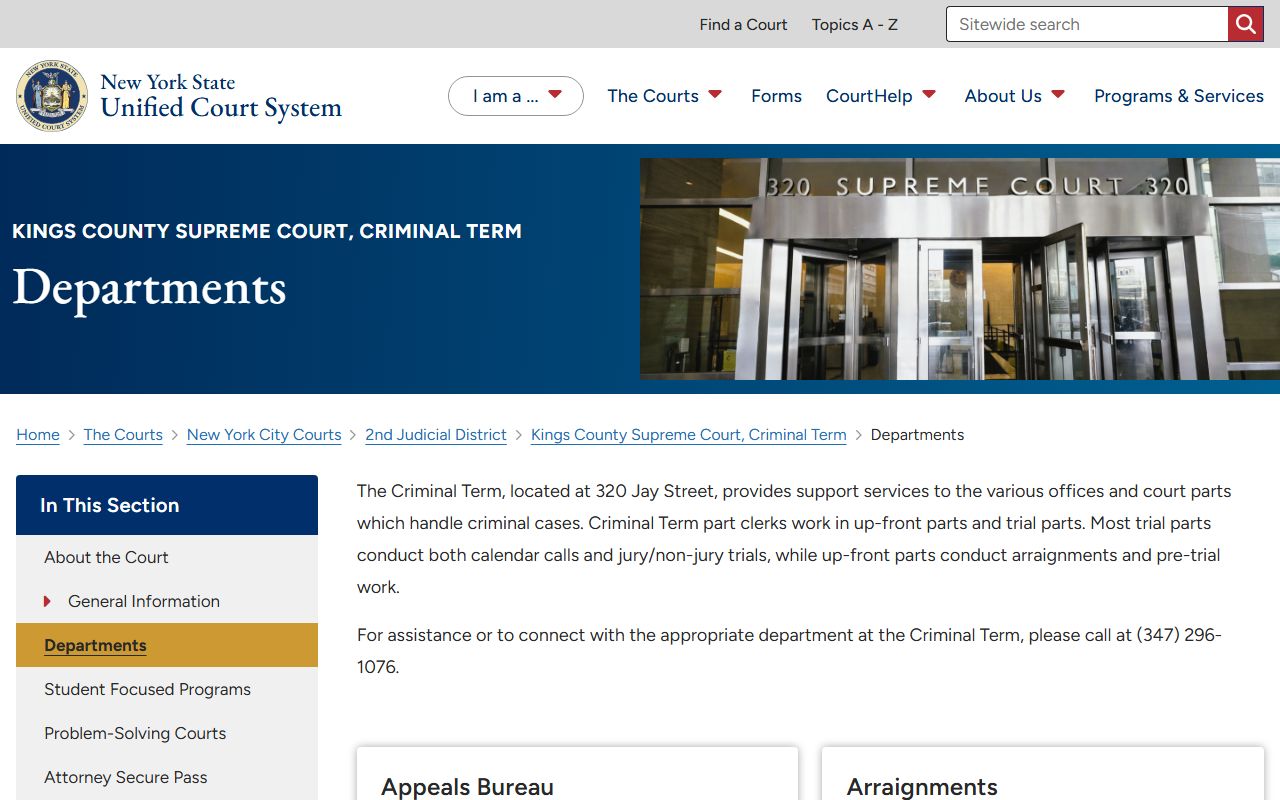
The page covers the Records Room, Warrant Clerk, Drug Court, and two Domestic Violence parts, all under one roof.
Types of Court Records Available in Kings County
Kings County court files cover the full range of civil and criminal life in Brooklyn. Some files are open to public view. Others are restricted by statute. Civil Supreme Court records include foreclosure files, matrimonial files, name-change petitions, mental hygiene files, elder law cases, and commercial litigation. Criminal court files include indictments, complaints, arraignment papers, motions, dispositions, sentences, and certificates of disposition. Surrogate's Court files include probate petitions, wills, estate accountings, and adoption papers.
Family Court holds child support, custody, visitation, abuse, neglect, foster care, family offense, and juvenile delinquency files. NYC Civil Court keeps small claims, housing, and consumer-debt files. The state-level vital records office and the NYC Office of the City Clerk hold the actual marriage records.
- Civil court records - foreclosure, matrimonial, mental hygiene, commercial, name change, and elder law cases at the Supreme Court Civil Term.
- Arrest records - NYPD booking data, criminal court dockets, and NYC DOC custody data are held by different offices; see Brooklyn arrest records.
- Family and divorce records - Family Court records are restricted; divorce files are held by Supreme Court Civil Term.
- Surrogate's Court records - estate files, wills filed for probate, and historical index books on Kings County Surrogate's Court.
- Traffic court records - NYC traffic tickets run through the DMV Traffic Violations Bureau and city courts depending on charge.
- Liens and judgments - the Kings County Clerk records civil judgments and liens against Brooklyn block-and-lot parcels.
What Kings County Court Records Show
A typical Kings County court file holds case-management data, the parties, the assigned justice, the docket entries, and any documents that the clerk allows the public to see. The exact fields depend on whether the record is civil, criminal, or a Surrogate's Court estate file. The table below maps the fields a user is most likely to see on a portal result.
| Field | What It Shows |
|---|---|
| Case Number | Civil index format NNNNNN/YYYY; NYC Criminal Court docket format CR-######-YYSU. |
| Filing Date | Date the case or proceeding was opened with the clerk. |
| Parties | Plaintiff and defendant, petitioner and respondent, or People v. defendant in criminal cases. |
| Case Type | Foreclosure, matrimonial, commercial, mental hygiene, felony, estate, adoption, or other class. |
| Assigned Justice or Part | The judge or court part that hears the case; used for calendar searches. |
| Disposition | Outcome of the case, including dismissal, judgment, plea, or settlement. |
| Documents | Decisions and e-filed documents that the clerk uploaded to NYSCEF or WebSurrogate. |
| Status | Open, disposed, sealed, transferred, calendared, or closed. |
Update timing matters. WebCivil Supreme updates Kings County data four times each day. WebCrims does not show warrants, finished cases, or sealed cases.
Public Access Laws for Kings County Court Records
New York treats agency records and court records under two different laws. The Unified Court System's official FOIL page says court case files are not handled through FOIL. Court records fall under Judiciary Law § 255. Agency administrative records are subject to the state Freedom of Information Law. Knowing which law applies helps a request go to the right office.
Court rules and sealing statutes also shape what is public. Many criminal records are sealed by statute when a case ends in a favorable termination. Family Court records and adoption records are restricted by law. Civil cases can be sealed only when a judge makes a written good-cause finding.
Key Statutes:
Public Officers Law §§ 84-90 (FOIL) - sets the public's right to inspect state and local agency records, with stated exemptions.
Judiciary Law § 255 - court records are kept and made available by the clerk under court rules, not under FOIL.
CPL § 160.59 - lets people seal certain convictions after 10 years on a court petition.
Family Court Act § 166 - keeps Family Court records out of indiscriminate public inspection.
Domestic Relations Law § 114 - seals adoption records and bars public access without a court order.
Records That Are Restricted or Confidential
Some Kings County court records will not appear in any free public search. Sealed records are removed from the public side of the portal. Adoption records are sealed under state law. Family Court records are not open to broad public view under Family Court Act § 166. Mental Hygiene Article 81 guardianship cases are excluded from WebCivil Supreme. Grand jury materials are not public.
To view a sealed record, a person usually must file a motion in the issuing court, show good cause, and serve the parties. The court can grant access in part, with redactions, or deny the motion. A Surrogate's Court file may be partly restricted under Uniform Rule 207.64, which keeps confidential personal information out of public view.
Specialty Courts in Kings County
Kings County Supreme Court Criminal Term runs problem-solving parts that route cases out of the standard track. The Drug Court takes felony and misdemeanor drug cases and offers treatment in place of jail. If the person finishes the treatment plan, the case is dismissed. The court also runs two Domestic Violence parts. Program coordinators sit in the courtroom to help victims.
Kings Family Court hosts Family Treatment Court for child welfare cases that involve substance use. The Brooklyn District Attorney's office also runs alternative programs and a re-entry track. People referred to these programs still have a court file, but the path through the system runs through the specialty part instead of a regular trial calendar.
Kings County Sheriff and Jail
Brooklyn does not have a county-run sheriff jail in the model used in many states. The NYC Department of Correction runs jail custody for everyone arrested in Kings County and held by the courts. The NYC Sheriff's Office sits inside the Department of Finance and handles civil warrants, service of process, and court-order enforcement. Most jail housing is on Rikers Island in Queens.
To find a person in NYC jail custody, use the NYC DOC person-in-custody lookup. For release alerts, register with VINELink or call 888-846-3469. State prison searches go through the NY DOCCS lookup. Federal custody is in the Bureau of Prisons locator. For more, see the Kings County inmate records page and the warrant records page.
Marriage, Divorce, and Surrogate's Court
Marriage records for Brooklyn are kept by the NYC Office of the City Clerk, not by the Kings County Clerk. Divorce is filed only at Kings County Supreme Court Civil Term, because New York routes all matrimonial actions through the Supreme Court. Estate filings, wills, and adoptions go to Kings County Surrogate's Court at 2 Johnson Street. See the dedicated marriage and divorce records page and the Surrogate's Court page.
The Surrogate's Court image below links to the official court page that lists judges and hours.
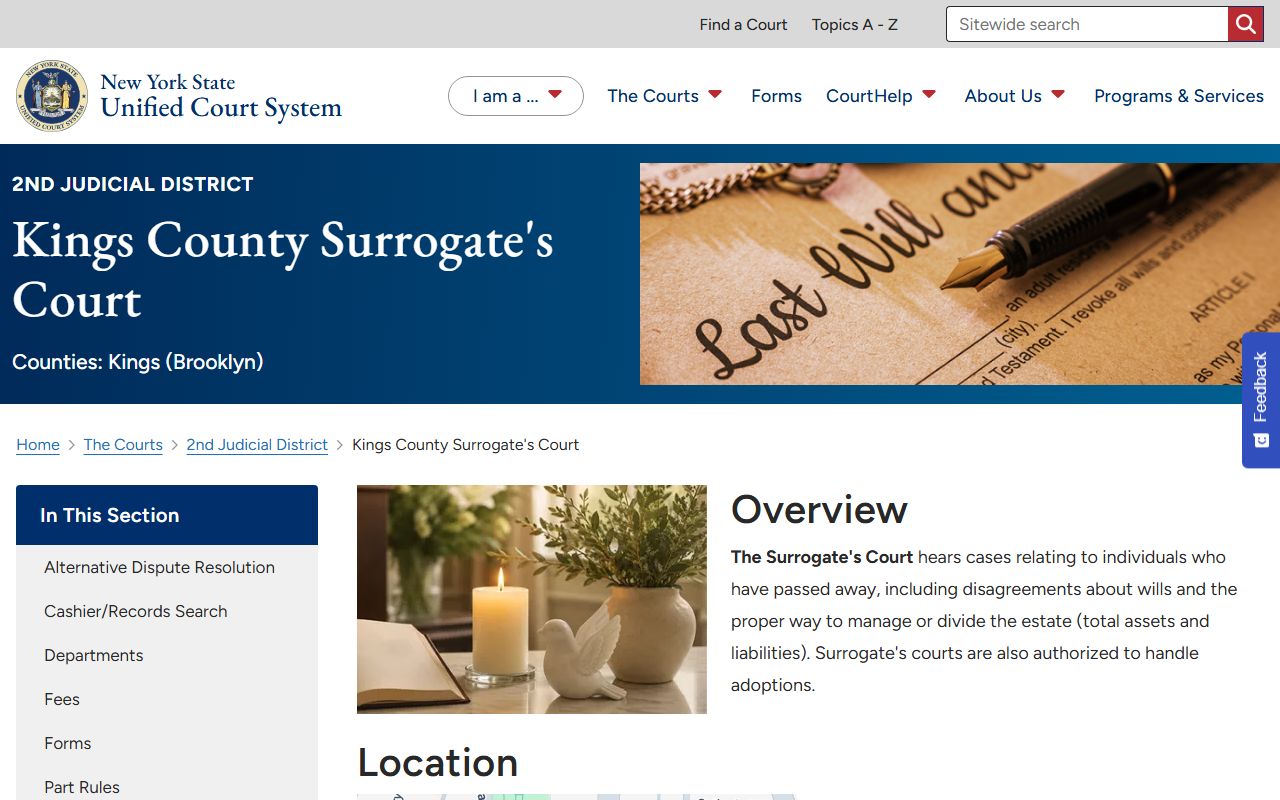
WebSurrogate is the free statewide portal that pulls from the same case files.
- Testator
- The person who made the will.
- Executor
- The person named in the will to manage the estate.
- Administrator
- The fiduciary appointed when there is no will or when the named executor cannot serve.
- Letters Testamentary
- The court order that gives the executor authority to act for the estate.
- Citation
- The Surrogate's Court process that tells an interested party to appear or respond.
Kings County Court Records Fees
Filing fees and copy fees vary by court. Surrogate's Court fees are set under SCPA § 2402 and depend on the size of the estate. NYC Sheriff fees apply when a civil warrant or summons is filed for service. The Kings County Clerk certifies Supreme Court documents and processes index numbers. FOIL copy fees from outside agencies are capped at 25 cents per page up to 9 by 14 inches unless another law sets a higher rate.
| Item | Amount |
|---|---|
| FOIL agency photocopy (state/local) | $0.25 per page |
| NYC Sheriff civil court arrest warrant filing | $120 |
| NYC Sheriff family court summons service | $57 (no fee for family offense summonses) |
| NYC Sheriff other summons or process | $57, plus $35 per extra service location |
| CPL § 160.59 sealing petition (NYC courts) | $10 |
| Surrogate's Court fees | Set under SCPA § 2402 by estate size and documents filed |
Note: Supreme Court civil filing fees and County Clerk certified-copy fees vary by document; confirm rates with the Clerk before filing.
How to Interpret Kings County Court Records
Court records use shorthand. A motion is a request for a court order. A note of issue says the civil case is ready for trial. An order to show cause sets a fast-tracked motion. In criminal cases, an arraignment is the first appearance after charging, ROR means released on recognizance, and remand means held without release. A dismissal with prejudice is final; without prejudice means the matter can be refiled.
Charges are not the same as convictions. A defendant can be charged with a felony, then plead to a misdemeanor, then have the case sealed years later. A certificate of disposition shows the final outcome of one criminal case, while a state rap sheet covers a broader criminal history kept by DCJS. When in doubt, request a certified copy of the disposition from the issuing court.
Accuracy and Record Limitations
Online court data can lag. NYC DOC custody data can lag 48 hours or more after arrest. WebCrims will not show a warrant. WebSurrogate links only to images filed after February 19, 2014. Sealed cases vanish from public portals altogether. A user who depends on online data for a legal decision should call the issuing court or visit in person to verify.
Note: Always confirm key details with the clerk before relying on online data for bail, custody, sentencing, deadlines, or sealing decisions.
Kings County Family Court
Kings County Family Court at 330 Jay Street hears child support, custody, visitation, abuse, neglect, foster care, family offense, and juvenile delinquency matters. The official Family Court page says every visitor must pass through a magnetometer. The court runs on-site interpreters for Spanish, Russian, Mandarin, Cantonese, Haitian-Creole, Arabic, and Bengali, with sign language and other languages on request.
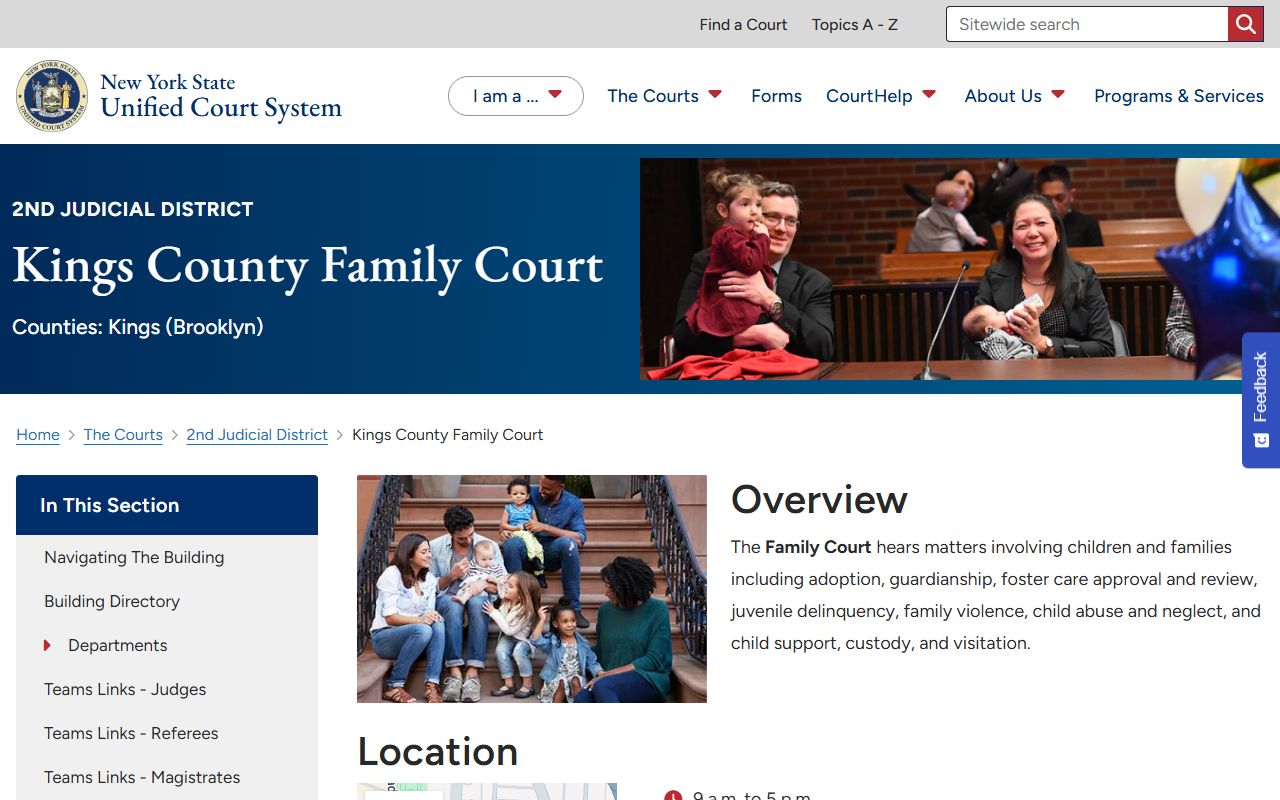
Family Court records are not open to broad public view. For details on confidential record routing, see the Kings County Family Court page.
History of Kings County Courts
Kings County is the same place as Brooklyn, one of New York City's five boroughs. The downtown court district grew up around Borough Hall in the 19th and 20th centuries. Civil court matters anchored around what is now 360 Adams Street. The Criminal Term building at 320 Jay Street is a more recent addition, described by the state as one of the most modern courthouses in New York.
Recent technology has reshaped how Brooklyn cases are filed and searched. WebCivil Supreme made civil case data searchable statewide. WebSurrogate did the same for estate records. NYSCEF brought electronic filing to civil and, on September 8, 2025, to authorized Kings County criminal case types. EDDS now lets the public submit PDFs to the court electronically for review.
Frequently Asked Questions
How do I search Kings County Supreme Court civil records?
Use WebCivil Supreme for case information and NYSCEF for e-filed matters. If the civil index number is known, search by index in the NNNNNN/YYYY format. If not, try a party search and limit the result to Kings County. The state FAQ confirms WebCivil Supreme updates Kings data four times a day.
Where are felony cases handled in Brooklyn?
Kings County Supreme Court Criminal Term at 320 Jay Street handles felony cases in New York City, including any case where a sentence over one year could be imposed. The phone line is 347-296-1076. The Criminal Term Records Room and Warrant Clerk are inside the same building.
Are court records the same as FOIL records?
No. The Unified Court System FOIL page says court records are governed by Judiciary Law § 255, not FOIL. FOIL covers state and local agency administrative records. To get a Kings County case file, ask the clerk or the records room of the court that holds the file.
Where do I search probate records?
Use WebSurrogate. The portal runs free Name Search, File Search, Old Index Search, Index Book Pages, and Will Search options. Restricted documents are blocked under Surrogate's Court privacy rules. The Kings County Surrogate's Court desk at 2 Johnson Street can also pull paper files.
Does Kings County run an active warrant search online?
No official public Kings County active warrant search has been published. WebCrims does not show warrants. The Criminal Term Records Room maintains warrant files. The NYC Sheriff's Office handles civil warrants. Anyone who suspects an active warrant should call a defense attorney before going to court.
More on the Kings County Court Records FAQ page.