
Kings County Warrant Search Reality
There is no public Kings County warrant list online. Official sources do not show an active criminal warrant search for Brooklyn. This surprises many people. The state criminal portal, WebCriminal, does not show warrants at all. It only shows upcoming criminal court dates in New York City. A warrant question cannot be answered by that tool. The honest path is different. A warrant is a court order, so the court or office that issued it holds the file.
Warrants in Kings County are issued and vacated by specific offices. The Kings County Supreme Court Criminal Term keeps completed criminal files and warrant files in its Records Room, where the Warrant Clerk works. The New York City Sheriff handles arrest warrants tied to court-order compliance and civil enforcement. Family Court issues its own warrants. So the right step is to match the warrant type to the right office, then ask that office directly.
Important: Do not trust any site that claims to list all Kings County warrants. No official public warrant search exists, and WebCriminal does not display warrants.
Types of Kings County Warrants
Warrants in Brooklyn are not all the same. A criminal bench warrant differs from a Family Court warrant. A civil contempt warrant differs from a Kendra's Law arrest. The office that issues each one also enforces or resolves it. Knowing the type tells you where to go. Below are the main forms found in Kings County matters.
- Arrest warrant - a legal order that lets police in New York City or State apprehend a named person.
- Bench warrant - issued by a judge, often after a missed court date in a criminal case.
- Civil contempt warrant - tied to failure to obey a court order, money judgment, subpoena, or jury summons.
- Family Court warrant - may issue when a summons cannot be served or a person fails to appear.
- Kendra's Law warrant - a Mental Hygiene Law order to take a person for a hospital or court hearing.
Some of these are not "criminal warrants" in the everyday sense. Family Court warrants can come from a service problem or a missed support hearing. Civil contempt warrants can flow from a divorce, separation, or annulment order. Kendra's Law warrants are treatment and compliance tools, not standard criminal process. Each demands its own handling.
The Criminal Term Warrant Clerk in Kings County
Felony cases in Brooklyn run through the Kings County Supreme Court Criminal Term. That court's Records Room holds completed criminal files. It also keeps warrant files, and the Warrant Clerk works there. Warrants are issued and vacated through this office. For a Supreme Court criminal warrant question, this is the place to start. Access depends on case status and court rules.
The Records Room sits at 320 Jay Street in Brooklyn. Bring identification and any case details you have. A docket or indictment number speeds the request. Defendant name and date of birth help when no number is known. The clerk can confirm whether a file exists, though sealed matters and certain orders stay closed to the public. For lower-court criminal matters, the NYC Criminal Court handles arraignments and misdemeanors, and bench warrants there follow that court's process.
Note: WebCriminal shows only upcoming court dates and never shows warrants, finished cases, or sealed cases, so it cannot clear a warrant question.
NYC Sheriff Civil Warrants and Court-Order Compliance
The New York City Sheriff's Office sits under the Department of Finance. It focuses on civil enforcement, process service, and court-order compliance. The Sheriff is mainly responsible for executing warrants tied to court orders. Arrest warrants are legal documents that let officers apprehend a named person. In most cases there is no fee to file an arrest warrant. Civil court arrest warrants may be filed with the Sheriff for $120.
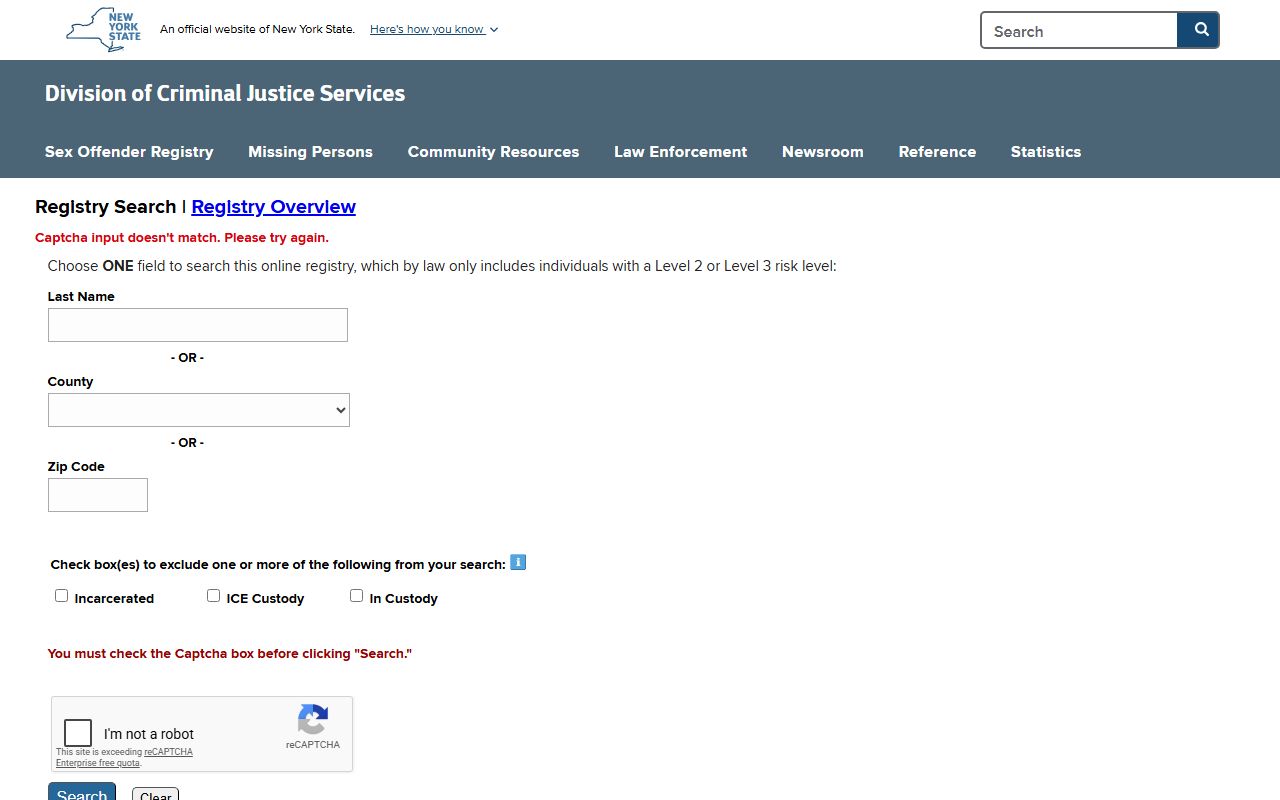
The Sheriff page covers several civil warrant forms. The picture below links to the state guide on searching the New York sex offender registry, one of the few statewide person-search tools that the public can run online.

That registry is a person lookup, not a warrant lookup, but it shows what a real public search tool looks like. Civil contempt arrest can follow failure to obey a court order or jury summons. It may enforce money judgments or orders in divorce, separation, or annulment matters. Disobedience to a subpoena can also trigger it.
To file a warrant with the Sheriff, the order must go to the county office where the named person lives, works, or is likely to be found. The office asks for the original or a certified copy of the warrant plus two photocopies. A completed Arrest Process Intake sheet is also required.
- Civil contempt warrant - for failure to comply with a court order, money judgment, or jury summons.
- Kendra's Law arrest - custody and transport for noncompliance with a mental-health order.
- Family Court warrant - when a summons fails, a person refuses it, or a respondent does not appear.
Kings County Warrant Search Fields
Since no official warrant portal exists for Brooklyn, the closest public person-search tool is the statewide sex offender registry. Its field set shows how a real search runs, and it stands in for the warrant search people expect to find. The table below lists the registry search fields. It is not a warrant database, and a clear result there does not mean a person has no warrant.
| Field Label | Type | Required | Notes / Format |
|---|---|---|---|
| Last Name | Text | Conditional | Used for the registry name search; a warrant is not returned here |
| First Name | Text | No | Narrows the registry result list |
| County | Dropdown | Optional | Choose Kings to limit results to Brooklyn |
| ZIP Code | Text | Optional | Filters registry results by area |
| Search | Button | Yes | Runs the registry query; does not check warrant status |
The picture below links to the official New York State sex offender registry search run by the Division of Criminal Justice Services.
For actual warrant status, skip the registry and go to the issuing court. The Sheriff's intake process, not a web form, is how civil warrants are filed and tracked.
What a Kings County Warrant Record Shows
When a warrant is pulled from an official court or clerk, the file holds specific details. These do not appear in a quick online search. They show up only once the issuing office produces the record. The table below maps the fields that most often appear on a Kings County warrant file.
| Field | What It Shows |
|---|---|
| Defendant / Respondent | Name of the person the warrant names. |
| Issuing Court and County | The court that signed the order and the county, such as Kings. |
| Case Number | Docket, indictment, Family Court, or civil case number. |
| Warrant Type | Bench, arrest, civil contempt, Family Court, or Kendra's Law order. |
| Issue Date | The date the warrant was signed. |
| Underlying Charge / Order | The charge, order, or proceeding behind the warrant. |
| Bail or Bond Condition | Any bail or bond amount set with the warrant. |
| Vacate / Recall Date | The date the warrant was resolved, if it has been. |
| Clerk Notation | Clerk note or judge signature and order. |
Return instructions and the producing agency may also appear. Not every field is public. Sealed matters, grand jury materials, and certain orders stay closed regardless of who asks.
How to Resolve a Kings County Warrant
A warrant does not clear itself. The right move depends on the warrant type and the court that issued it. Criminal bench warrant handling differs from Family Court warrants and civil contempt warrants. A missed court date can create a bench warrant, but the remedy is not the same across court types. The steps below outline the safe path.
- Do not rely on WebCriminal to clear a warrant question, because it does not show warrants.
- Contact the issuing court or your attorney to confirm whether a warrant exists.
- For Supreme Court criminal matters, reach the Kings Criminal Term Records Room or clerk channels.
- For Sheriff civil warrants, follow the NYC Sheriff intake instructions and county office routing.
- If there is any arrest risk, consult defense counsel before you appear.
- Bring identification and your case or warrant details to any appearance.
- Pay bail, fines, or surcharges only through official court or authorized channels.
Important: Talk to a lawyer before you turn yourself in on a warrant; counsel can arrange a surrender, address bail, and protect your rights.
The Attorney Role and Indigent Defense
An attorney can do what a public search cannot. Counsel can confirm a warrant, contact the right clerk, and plan a surrender. In criminal cases, counsel may be assigned at arraignment if a person qualifies financially. Two main providers handle indigent defense in Brooklyn. The Legal Aid Society and Brooklyn Defender Services represent people who cannot afford a private lawyer.
The Brooklyn District Attorney's Office, led by Eric Gonzalez, prosecutes criminal cases in Kings County. Its main Action Center line is 718-250-2340. The office runs many bureaus, but it does not clear a defendant's warrant on request. That is a court function. For victims tied to a case, the Victim Services Unit can be reached at 718-250-3820. A defense lawyer, not the prosecutor, is the right contact when you face a warrant.
Court-appointed counsel and institutional defenders differ. Institutional defenders are contracted organizations. Assigned counsel or private attorneys may come from panels where appropriate. Either way, having a lawyer involved before any court appearance is the safest course on a Brooklyn warrant.
Restricted Kings County Warrant Records
Not every warrant file is open. Sealed criminal matters do not appear in public results, and the underlying warrant follows the case. Family Court records are not open to indiscriminate public inspection under Family Court Act § 166, so Family Court warrants are generally restricted. Juvenile delinquency matters fall under the same confidentiality framework. Grand jury materials are not public.
Out-of-state warrants and extradition are not handled by the NYC Sheriff page. Those need law-enforcement and court-specific handling. Federal warrants run through federal agencies, not Brooklyn courts. If a person is arrested on a warrant, custody data may move through police, court, the city Department of Correction, state, or federal systems depending on the warrant type and the case. The path is rarely a single office.