
What a Kings County Court Docket Shows
A docket is the running list of events tied to a case. Each new motion, order, appearance, or filing adds a line. For Kings County, the docket may live in WebCivil Supreme, WebCriminal, NYSCEF, or WebSurrogate, depending on the case class. The format is not the same in each tool. WebCivil Supreme shows the civil Supreme Court calendar by index number and by part. WebCriminal shows the next court date for open criminal cases. NYSCEF lists each e-filed document by line number. WebSurrogate lists estate-file activity by file number.
The data points across these tools overlap. A docket entry will name the case, the parties, the court part or assigned justice, the filing date, the entry type, and the next appearance date if one is set. Some entries link to scanned decisions or e-filed PDFs. Other entries are calendar lines only, with no document attached. Brooklyn cases that are sealed, finished, or restricted by statute will be missing. Article 81 Mental Hygiene cases stay off WebCivil Supreme. Family Court calendars are not open to broad public docket lookup under Family Court Act section 166.
| Field | What It Shows |
|---|---|
| Case Caption | Plaintiff v. defendant, petitioner v. respondent, estate name, or People v. defendant. |
| Index / Docket Number | Civil index NNNNNN/YYYY, criminal docket CR-######-YYSU, or Surrogate's Court file number. |
| Filing Date | Date the action or proceeding was opened with the court. |
| Justice / Part | Assigned judge or court part hearing the case. |
| Motion / Entry Type | Motion, order to show cause, conference, note of issue, decision, judgment, or stipulation. |
| Appearance Date | Next scheduled hearing, conference, or appearance. |
| Disposition | Dismissal, judgment, plea, sentence, decree, or settlement. |
| Status | Open, disposed, sealed, transferred, calendared, or closed. |
Docket entries are short by design. The full text of an order, motion, or affidavit lives in the case file or in NYSCEF.
WebCivil Supreme Calendar Search
WebCivil Supreme is the main tool for Kings County Supreme Court civil dockets. The site covers civil Supreme Court cases in all 62 New York counties. The official WebCivil Supreme FAQ says data is sent in from court case-management systems and refreshed for Kings County four times each day. The image below links to that FAQ, which lists field rules and coverage notes for Brooklyn civil cases.
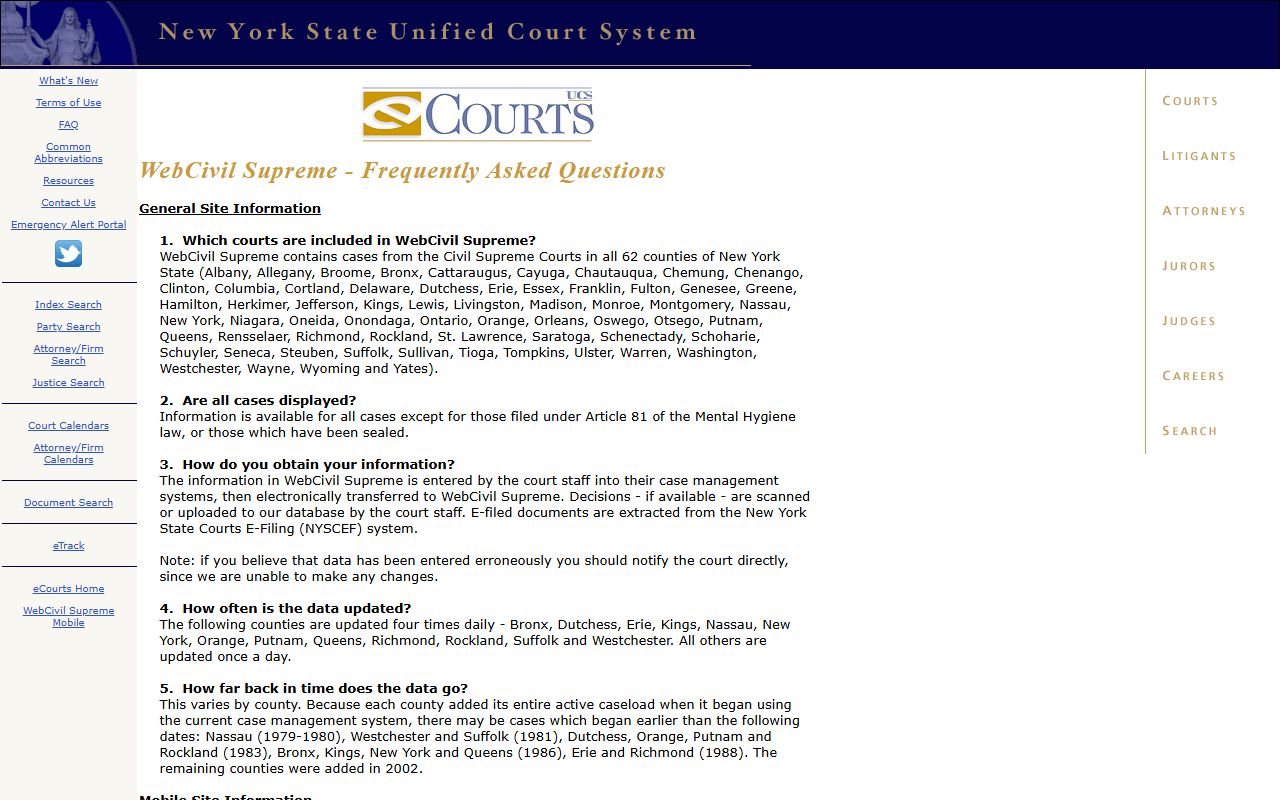
Four search modes drive WebCivil Supreme. Index Search is fastest if the index number is known. Party Search works by name. Attorney/Firm Search returns the cases handled by a given lawyer or firm. Justice/Calendar Search pulls the calendar for a chosen part or justice. The portal lets the user limit the lookup to Kings County so the result list stays short. Sealed cases and Article 81 Mental Hygiene cases never appear in the result list, even when the index number is entered correctly.
| Field Label | Type | Required | Notes / Format |
|---|---|---|---|
| What to Search | Radio/tab | Yes | Index, Party, Attorney/Firm, or Justice/Calendar mode |
| Index Number | Text | Conditional | Format NNNNNN/YYYY; up to six digits plus four-digit year |
| Party Name | Text | Conditional | Full or partial name; useful when no index number is known |
| Attorney / Firm | Text | Conditional | Search by attorney or firm; can drive attorney calendar lookup |
| Justice or Court Part | Dropdown | Conditional | Pick county first, then pick justice or part; press Find Calendar |
| Limit Search by Court(s) | Multi-select | Optional | Pick Kings County Supreme Court; Ctrl-click for added counties |
| Output Selection | Radio | Yes | HTML or PDF result list |
Try the live tool through the official WebCivil Supreme search page. The Kings County Supreme Court Civil Term page also links the same portal under its civil case lookup resources.
WebCriminal Calendar and Part Search
WebCriminal, also called WebCrims, is the state's tool for the next court date on open Brooklyn criminal cases. It covers Kings County Supreme Court Criminal Term and the NYC Criminal Court parts that sit in Brooklyn. The image below links to the live WebCriminal defendant search, which is the main entry form.
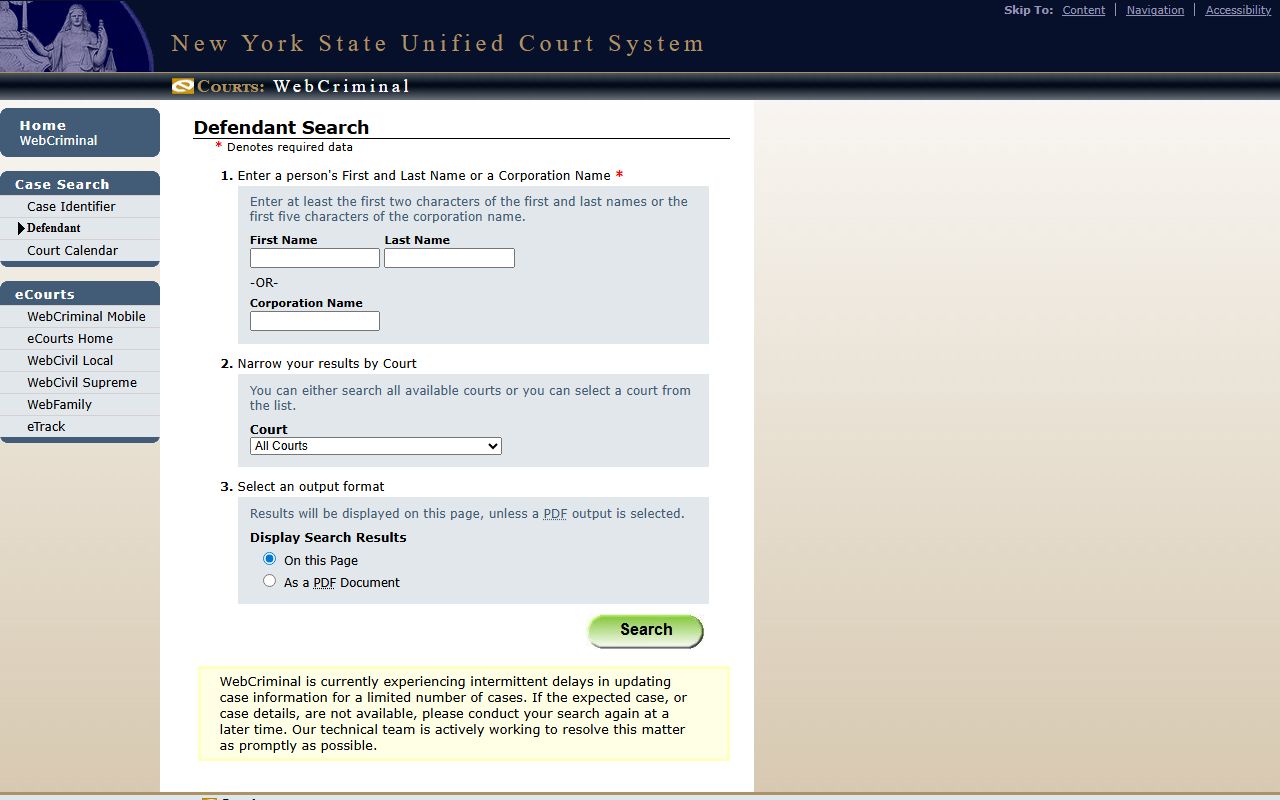
Name search needs at least the first three letters of the last name and the first two letters of the first name. Case-number search uses the full docket in CR-######-YYSU format. Court Calendar search uses the court field and the courtroom or part number, such as D31 or D44, not the judge's name. WebCrims will not show warrants. It will not show finished cases. It will not show sealed cases. For those, the user must reach the Criminal Term Records Room at 320 Jay Street, which is the office described on the Kings County Supreme Court Criminal Term page.
For a deeper walk-through, the CourtHelp WebCrims guide spells out each search mode in plain text. It is helpful when the name returns too many hits or the docket number format is unclear.
NYSCEF and Docket Entries for E-Filed Cases
NYSCEF is the state's e-filing system. For e-filed Kings County cases, NYSCEF is the docket. Each line in a NYSCEF case is numbered. Each line shows the document type, the date it was filed, and the filing party. Many lines link to a PDF that any visitor can open and read. The NYSCEF case search takes an index number, a party name, or an attorney name. The lookup runs across all participating courts statewide, and the case detail page shows the full docket entry list.
NYSCEF started on the civil side. It expanded over time. On September 8, 2025, Kings County Supreme Court Criminal Term became one of the first criminal courts to launch NYSCEF for authorized criminal case types. That move added some Brooklyn felony filings to the e-filed docket pool. Not every criminal case is e-filed, and not every civil case is e-filed. WebCivil Supreme and NYSCEF do cross-reference. When a WebCivil Supreme case is also on NYSCEF, the case detail page links across.
Note: WebCivil Supreme refreshes Kings County data four times each day. NYSCEF posts e-filed entries as soon as the filer's submission clears the system, but court review can still adjust how a line appears.
The eCourts hub links WebCivil Supreme, WebCrims, NYSCEF, and WebSurrogate from one page, which keeps it easy to flip between docket systems during a single lookup.
Surrogate's Court File Activity
Surrogate's Court keeps its own docket. In Kings County, that court sits at 2 Johnson Street. Estate files, will probate petitions, administration petitions, accountings, and guardianship matters all live there. The public tool is WebSurrogate, shown in the image below. WebSurrogate lists file activity for Surrogate's Court cases across the state and provides links to many document images.
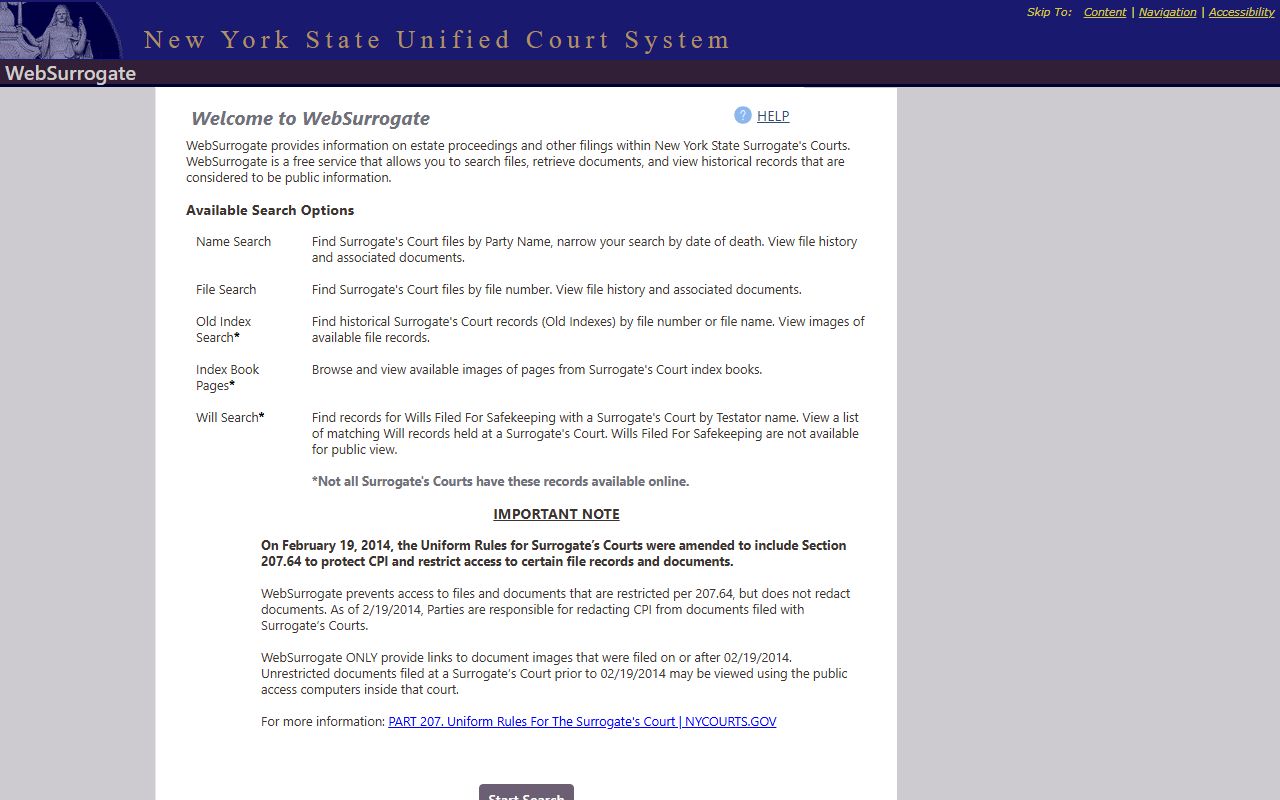
Five search modes drive the tool. Name Search finds a file by the decedent or party name and can narrow by date of death. File Search uses the Surrogate's Court file number. Old Index Search looks up historic estate records by file number or file name. Index Book Pages lets a visitor browse images of old index-book pages. Will Search finds wills filed for safekeeping by testator name, though those wills are not public to view. Uniform Rule 207.64 blocks access to certain file records and documents that hold confidential personal information. WebSurrogate enforces that rule by hiding restricted documents, but it does not redact pages on its own.
One coverage detail to keep in mind: WebSurrogate only links to document images filed on or after February 19, 2014. Older Kings County estate documents can be viewed on the public access computers inside the Surrogate's Court building. The Kings County Surrogate's Court page covers in-person access rules in more detail.
Reading Docket Entries
Docket entries use short legal terms. A first read can feel dense. A few quick translations help. "Motion to dismiss" is a request that the case end without trial. "Order to show cause" is a judge-signed order that sets a fast motion track, often with a return date noted on the line. "Note of issue" tells the court the case is ready for trial. "Decision and order" is the judge's ruling on a motion. "Stipulation" is a written deal between the parties, sometimes "so-ordered" by the judge. "Disposed" means the case has reached a final outcome on the books.
Criminal entries follow their own pattern. "Arraignment" is the first court date after the charge. "Plea" is the line that records a guilty or not-guilty plea. "Sentence" is the line that records the punishment. "Bail set" and "remand" are bail-status lines. "Adjournment in contemplation of dismissal" is a special outcome that can lead to dismissal and sealing after a set wait. Estate dockets in WebSurrogate use "decree," "letters testamentary," and "letters of administration" for the orders that grant authority over an estate. Each line is short. Each line is part of a longer paper trail.
If a line is unclear, the underlying document is the source of truth. For e-filed cases, click the line in NYSCEF to open the PDF. For older cases or non-e-filed cases, the file room at the relevant court holds the paper. The Kings County Clerk handles Supreme Court civil files. The Criminal Term Records Room handles felony files. The Kings County Supreme Court page lists which office serves which need.
How to Pull a Kings County Docket
A docket pull is a short workflow. The steps below cover the common path for a civil case where the index number is known or can be found by party name. Steps shift slightly for criminal, estate, or e-filed lookups, but the order of work stays the same: pick the portal, narrow by county, find the case, open the docket, and grab any linked PDFs.
- Pick the portal that matches the case class. Use WebCivil Supreme for civil Supreme Court, WebCrims for open criminal cases, NYSCEF for e-filed civil cases, or WebSurrogate for estate files.
- Open the search form and pick a mode. Index or docket number is fastest. Party name works when no number is known. Justice or part calendar works when only the courtroom is known.
- Limit the lookup to Kings County. WebCivil Supreme uses a multi-select court list. WebCrims uses a court dropdown. NYSCEF uses a county filter on the results page.
- Run the search. Pick HTML or PDF output where the portal asks. Open the case detail page for the matching result.
- Read the docket entries from top to bottom. Note the assigned justice or part, the next appearance date, and the last filed line. Click any entry that has a PDF icon to view the document.
- For a certified docket sheet or a sealed-record question, contact the issuing court. Civil cases go through the Kings County Clerk at 360 Adams Street, Room 189. Criminal cases go through the Criminal Term Records Room at 320 Jay Street.
Update Frequency and Coverage Gaps
Update timing is different across the four portals. WebCivil Supreme refreshes Kings County data four times each day. That cadence is fast enough to catch most calendar moves, but a late-day filing may not show until the next refresh window. WebCrims posts upcoming court dates and updates them as the court schedule changes. NYSCEF posts an e-filed line right after submission, though the court can mark the line for review or correct it later. WebSurrogate's date depth varies by file and by court, and the system only links to images filed on or after February 19, 2014.
Coverage gaps are just as important. WebCivil Supreme excludes Article 81 Mental Hygiene cases and any sealed civil case. WebCrims will not show warrants, finished cases, or sealed cases. NYSCEF only holds e-filed cases, so a paper-only Brooklyn case will not appear there at all. WebSurrogate hides wills filed for safekeeping and blocks documents flagged under Uniform Rule 207.64. Family Court calendars are not open to broad public docket lookup under Family Court Act section 166. If a case cannot be found in any portal, the next step is the issuing court's records room or clerk.
Old cases can also be a problem. Kings may include cases that began before 1986 because the county added its active caseload when the current system started, but date depth is not promised. Long-finished cases may still be in the index even when no docket detail is shown online. Paper files at the Kings County Clerk fill that gap for civil matters, while the Criminal Term Records Room holds the equivalent paper trail for felony files.
Sealed and Finished Cases That Will Not Appear
Several statutes seal or hide Kings County cases from any public docket. CPL section 160.50 seals criminal records after a favorable termination. CPL section 160.55 seals most violations and traffic infractions on conviction. CPL section 160.59 lets eligible people seal certain older convictions ten years after sentence or release. Family Court Act section 166 keeps Family Court records off broad public view. Domestic Relations Law section 114 seals adoption records. Uniform Rule 216.1 sets the good-cause finding rule for civil sealing.
A case touched by any of those rules will be missing or thin in a portal result. WebCrims tells users it will not show finished cases. That is by design. A finished case file does still exist at the court of record. To view a sealed file, a person usually files a motion in the issuing court, shows standing, and serves the parties. The judge may grant access in part, grant full access, or deny the motion. The arrest records page covers the criminal side of this access path in more detail.
One more gap to flag: Article 81 Mental Hygiene guardianship cases. WebCivil Supreme excludes those by rule. The case may still exist on paper in the clerk's office, but it will not return in any WebCivil result list, even with the right index number. A motion in the issuing part is the route for access.
Court Parts and Justices in Kings County
Kings County Supreme Court runs in two terms. Civil Term sits at 360 Adams Street. Criminal Term sits at 320 Jay Street. Each term divides its work into parts. A part is a courtroom run by one assigned justice or referee on a set caseload. WebCivil Supreme's Justice/Calendar search asks for the county, then offers the part or justice list. The user picks a part or a justice and presses Find Calendar. The result is the calendar for that part on the chosen day or term.
Criminal Term parts include problem-solving and specialty parts, such as Drug Court and two Domestic Violence parts. Civil Term parts run general civil, matrimonial, foreclosure, mental hygiene, name change, commercial, and elder law tracks. Each part has its own calendar style. Some parts run conference days. Some parts run motion days. Some parts run trial-ready days. The part page on the court site lists the part's specific schedule and any special rules.
Brooklyn's Criminal Term page and the Civil Term page each list current part assignments and contact details. Surrogate's Court runs through its surrogates, with chambers and clerks at 2 Johnson Street. Family Court has its own part list housed at 330 Jay Street.
Getting Certified Docket Sheets
The free state portals are research tools. They do not issue certified copies. For a court-stamped docket sheet or certified disposition, the request goes to the issuing court. Civil Supreme Court certified docket sheets come from the Kings County Clerk at 360 Adams Street, Room 189. The Record Room is in Room 079, open 9 AM to 5 PM. Criminal Supreme Court certificates of disposition come from the Criminal Term Records Room at 320 Jay Street. Surrogate's Court certified copies come from 2 Johnson Street.
Bring a government ID. Bring the index or docket number if known. Bring the party name if no number is known. Pay any certification fee at the counter. Fees and exact rules can change. Confirm the current cost at the clerk's window or by phone before traveling. For lower NYC Civil and Criminal Court records, the file is at the courthouse where the case sat, not at the Supreme Court Clerk. For Family Court, access is limited under Family Court Act section 166, so most requests go through the Family Court Clerk and the case's parties or attorneys.
For other follow-up paths, the Kings County court records page covers the full set of free portals and clerk offices in one place. The FAQ page answers many of the smaller "where do I go for X" questions that come up during a docket pull.