
About Kings County Family Court
Family Court in Brooklyn handles matters that involve children and family relationships. It is a separate court from the trial court that hears felonies and big-money civil cases. The building stands at 330 Jay Street, a short walk from the Criminal Term and the County Clerk. Doors open at 8:30 AM, and petitions can be filed starting at that time. The court keeps regular weekday hours.
This court does a lot of work for one borough. It hears child support and custody fights. It hears visitation and paternity cases. It decides abuse and neglect petitions, foster care reviews, and juvenile delinquency matters. It also issues orders of protection in family offense cases. One thing it does not do is grant divorces. In New York, divorce is a Supreme Court matter, not a Family Court one.
The court serves a borough where many languages are spoken every day. On-site interpreters cover Spanish, Russian, Mandarin, Cantonese, Haitian-Creole, Arabic, and Bengali. Other languages, including sign language, can be set up on request. There is a lactation room on the first floor, inside the Children's Center. Everyone who comes in must pass through a magnetometer, so plan to arrive early enough to clear security.
Kings County Family Court Case Types
Family Court does not hear every dispute between relatives. It hears the case types the law assigns to it. The table below sorts the main matters this Brooklyn court decides and shows what each one covers. Some of these case types carry extra privacy on top of the general rule, which the later sections explain.
| Case Type | What It Covers |
|---|---|
| Child Support | Petitions to set, change, or enforce support for a child; paternity may come up first. |
| Custody and Visitation | Who a child lives with and the schedule for parenting time with each parent or guardian. |
| Paternity | Legal finding of who a child's father is, often a first step before support or custody. |
| Family Offense | Requests for an order of protection when one family or household member harms another. |
| Child Abuse and Neglect | Petitions, usually by a child welfare agency, claiming a child is at risk in the home. |
| Foster Care | Approval and review of foster placements and permanency planning for children in care. |
| Juvenile Delinquency | Cases where a young person is accused of an act that would be a crime for an adult. |
| PINS | Person In Need of Supervision cases for youth whose behavior is beyond a parent's control. |
| Guardianship and Adoption | Guardianship of a child and certain adoptions; adoption files carry added confidentiality. |
Each case type follows its own petition and its own track. A support case moves through a Support Magistrate. A delinquency case has its own rules built to protect a child. Many people show up at 330 Jay Street expecting one type of relief and learn their issue belongs in another court entirely.
Where Family Court Sits in the System
It helps to see how Family Court fits next to the other Brooklyn courts. New York's trial-level structure is split by subject. Family Court takes child and family matters. Supreme Court takes the highest civil and felony cases, plus all divorces. Surrogate's Court takes estates and most adoptions. Each court keeps its own files and its own clerk.
- Family Court at 330 Jay Street: custody, support, visitation, paternity, family offense, abuse and neglect, foster care, delinquency, and PINS.
- Supreme Court, Civil Term at 360 Adams Street: divorce, separation, annulment, foreclosure, and major civil cases.
- Supreme Court, Criminal Term at 320 Jay Street: felony criminal cases in Brooklyn.
- Surrogate's Court at 2 Johnson Street: wills, estates, and many adoptions.
The split matters for searching. A custody order is a Family Court file. A divorce judgment that also sets custody is a Supreme Court file. For estate and most adoption matters, see the Surrogate's Court page. For a wider view of every court file in the borough, the Kings County court records page lays out the state portals.
Why Family Court Records Are Confidential
The biggest surprise for most people is that Family Court files are not public records in the usual sense. The lead-in here matters. State law shields these files by design. The rule comes from Family Court Act § 166, which says the records of the court are not open to indiscriminate public inspection. The statute page below sets out that protection.
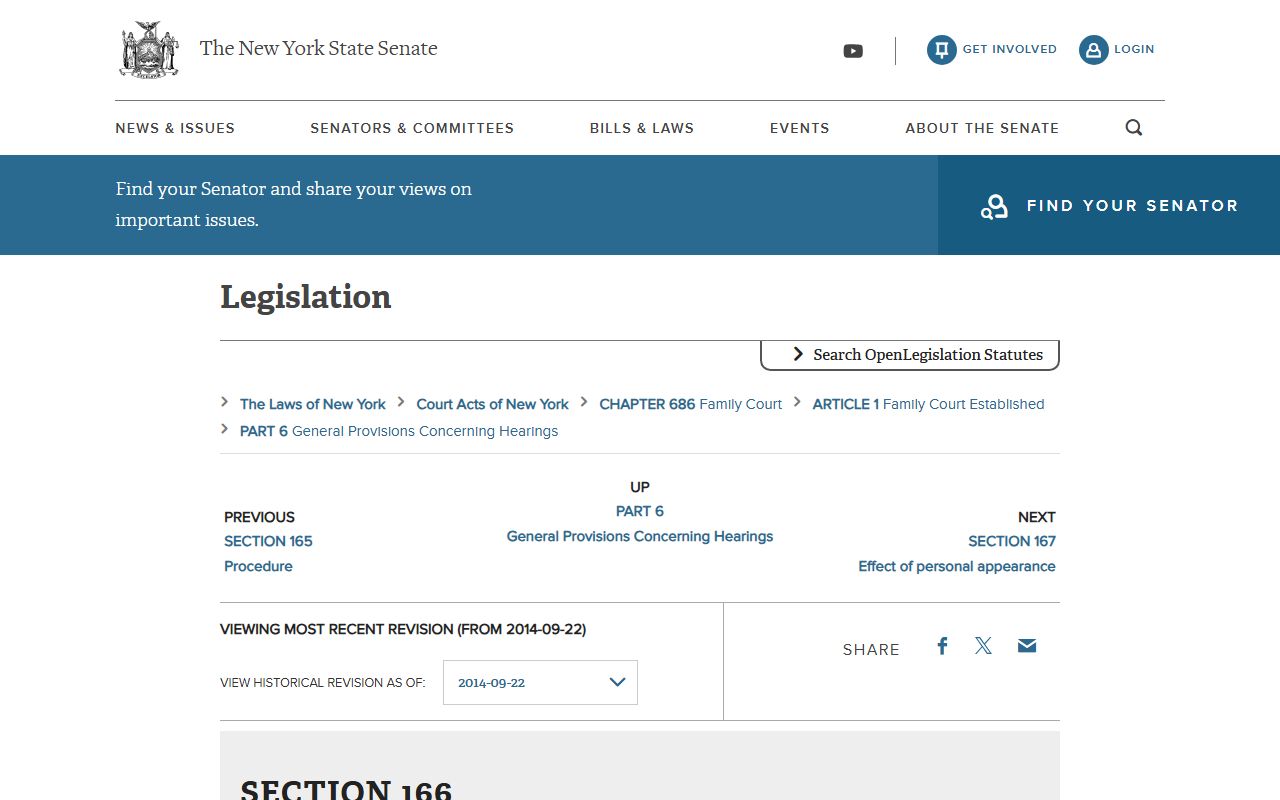
Under that section, access turns on who you are. A party to the case can usually see and copy the file. So can that party's attorney. Authorized agencies and people the court lets in by order can also gain access. A stranger with mere curiosity cannot. This is why a public portal search for a Brooklyn custody or support case turns up nothing. The records are simply not laid open for anyone to browse.
Some case types carry an extra layer. Juvenile delinquency files are guarded more tightly because they involve children accused of wrongdoing. Adoption records get sealed under Domestic Relations Law § 114, which withholds them from inspection and usually requires a court order to open. So even a party may face limits on parts of a sealed adoption file.
How to Get Your Own Family Court Record
If you are a party, you have a path to your own file. You do not file a broad public-records request the way you would for an agency record. You go to the court that holds your case. Bring proof of who you are. The steps below outline the usual route at the Kings County Family Court records room.
- Find your docket number if you have it. A docket or file number speeds the search and helps staff pull the right matter.
- Go to the Kings County Family Court at 330 Jay Street, or contact the court to ask about its current request method.
- Show a government photo ID and explain that you are a party, an attorney for a party, or otherwise allowed access.
- Ask for the documents you need, such as an order, a petition, or a copy of a prior decision in your case.
- If a sealed item or a delinquency or adoption record is involved, expect to need a court order before any copy is released.
Note: Court staff cannot give legal advice, so a litigant who is unsure about rights or next steps should speak with a lawyer or the court's help center.
Who May Access a Kings County Family Court File
Access lines up with the confidentiality rule. The court does not hand files to the public, but it does serve the people the case belongs to. The short definition list below names the roles that usually qualify, in plain terms, so a reader can see where they stand before making a trip to 330 Jay Street.
- Party
- A petitioner or respondent named in the case, such as a parent in a custody or support matter.
- Attorney of Record
- The lawyer representing a party in the matter, including an attorney for the child.
- Authorized Agency
- A child welfare or government body the law allows to see certain Family Court files.
- Person With Court Permission
- Someone a judge lets view a file by order, often after showing a real and proper reason.
A grandparent, a reporter, a landlord, or a future employer does not fit these roles by default. They would need a court order to view a file. The general public cannot pull a Brooklyn family case the way they can pull a civil index number or an estate file.
Divorce Goes to Supreme Court, Not Family Court
This trips up many Brooklyn residents. Family Court does not grant divorces in New York. The only court that can end a marriage is the Supreme Court. People sometimes file a support or custody petition in Family Court while a divorce runs in Supreme Court, so the two courts can hold related but separate files at the same time.
If your goal is the divorce case itself, that file lives at the Supreme Court, Civil Term. The matrimonial papers and the judgment of divorce are Supreme Court records. For where those files are kept and how to request them, see the Kings County Supreme Court page. For the difference between a divorce decree, a divorce certificate, and a marriage record, see the marriage and divorce records page.
Family Court can still set support and decide custody for unmarried parents, or after a divorce is over. So a parent may use Family Court without ever filing for divorce at all.
Kings County Family Court Contact Information
For questions about a Brooklyn family case, the court itself is the right first stop. The contact card below lists the address, phone, email, and hours pulled from the official court listing. Keep in mind the magnetometer screening at the door, and arrive with time to spare.
Kings County Family Court
330 Jay Street
Brooklyn, NY 11201
347-401-9610
kingsfamilycourt@nycourts.gov
Mon-Fri 9 AM-5 PM; doors open 8:30 AM
The court cluster in Downtown Brooklyn is walkable. The 330 Jay Street building sits near the Criminal Term at 320 Jay Street and a short way from the County Clerk at 360 Adams Street. Transit is the practical way in, with several subway lines stopping near Borough Hall and Jay Street.
Self-Help and Legal Aid Resources
Many people stand before Family Court without a lawyer. There is help built for them. The court runs self-represented services and a help center, and the state hosts a free self-help website with information and forms. The list below points to the main resources for a Brooklyn family case.
- CourtHelp gives statewide self-help guides for people without a lawyer.
- The Kings Family Court Self-Represented Services and a Virtual Help Center support pro se litigants in Brooklyn.
- The Legal Aid Society handles juvenile, family, and civil matters across New York City.
- Brooklyn Defender Services offers family, civil, and related representation for Brooklyn residents.
- The Brooklyn Family Justice Center, listed by the District Attorney, can be reached at 718-250-5111.
People facing a family offense case can also reach the Brooklyn DA Victim Services Unit at 718-250-3820. For broader access rules across every record class in the borough, the public records page explains the state's two parallel frameworks, and the criminal court page covers matters that may overlap with a family offense charge.