
How to Find Recent Kings County Arrest Records
There is no single Brooklyn arrest list that the public can pull up online. An arrest record is built in stages, and each stage lives with a different office. NYPD holds the initial arrest paperwork. The Brooklyn DA holds the prosecution file. NYC DOC holds custody data once a person is committed at arraignment. The court system holds the docket on the case after charges are filed. Each of those offices runs its own database, and each has its own access rule. The fastest path is to pick the stage that matches the question.
For someone believed to be in city jail, the NYC DOC person-in-custody lookup is the right tool. It returns the current facility and basic case data for people held by NYC DOC. It does not cover police custody, state prison, or federal lockups. For release alerts, callers use VINELink at 888-846-3469. For statewide criminal history, the New York State Division of Criminal Justice Services holds the rap sheet, though that file is not open to the general public.
- Confirm the borough and the agency that made the arrest. NYPD precincts cover Brooklyn neighborhoods.
- Check the NYC DOC person-in-custody lookup if the person may still be held in city jail.
- If the lookup shows nothing, allow time. DOC data can lag the arrest by 48 hours or more.
- Use WebCrims for upcoming court dates on a live criminal docket in Brooklyn.
- Call VINELink at 888-846-3469 to register for release and transfer alerts.
- For a certificate of disposition once the case ends, use the Criminal Term Records Room at 320 Jay Street.
The Path from Arrest to Court
An arrest in Brooklyn does not end at the precinct. The arrested person is fingerprinted, photographed, and screened. NYPD then either issues a Desk Appearance Ticket and sends the person home with a future court date, or holds the person for arraignment. Arraignment usually takes place at NYC Criminal Court at 120 Schermerhorn Street, where a judge sets bail, releases the person, or remands. Once a felony is voted by a grand jury, the case moves up to Kings County Supreme Court Criminal Term at 320 Jay Street. The arrest record itself stays with the police and the prosecutor, while the court docket grows on its own track.
Charges can shift along the way. The Brooklyn DA, led by District Attorney Eric Gonzalez, reviews the arrest, talks to witnesses, and decides whether to file the case as charged, change the charges, or decline. Some cases are routed to diversion or treatment court. That means an arrest does not equal a charge, and a charge does not equal a conviction. A public records search should follow that order: arrest first, then the filed complaint or indictment, then the disposition.
NYC DOC Custody After a Brooklyn Arrest
Once a Brooklyn judge sets bail and the person cannot post it, or once a judge remands, custody passes to the New York City Department of Correction. NYC DOC runs the city jails. Most people held after a Kings County arraignment land at Rikers Island, though specialized housing exists at Bellevue Hospital Outposted Therapeutic Housing Units for complex medical needs. A Kings County arrest record does not always mean a Brooklyn jail stay, because DOC places people across its facility system based on classification, medical status, and security needs.
The image below links to the Brooklyn District Attorney's office page for Eric Gonzalez, which lists the prosecution unit phone numbers used to track a case after arrest.
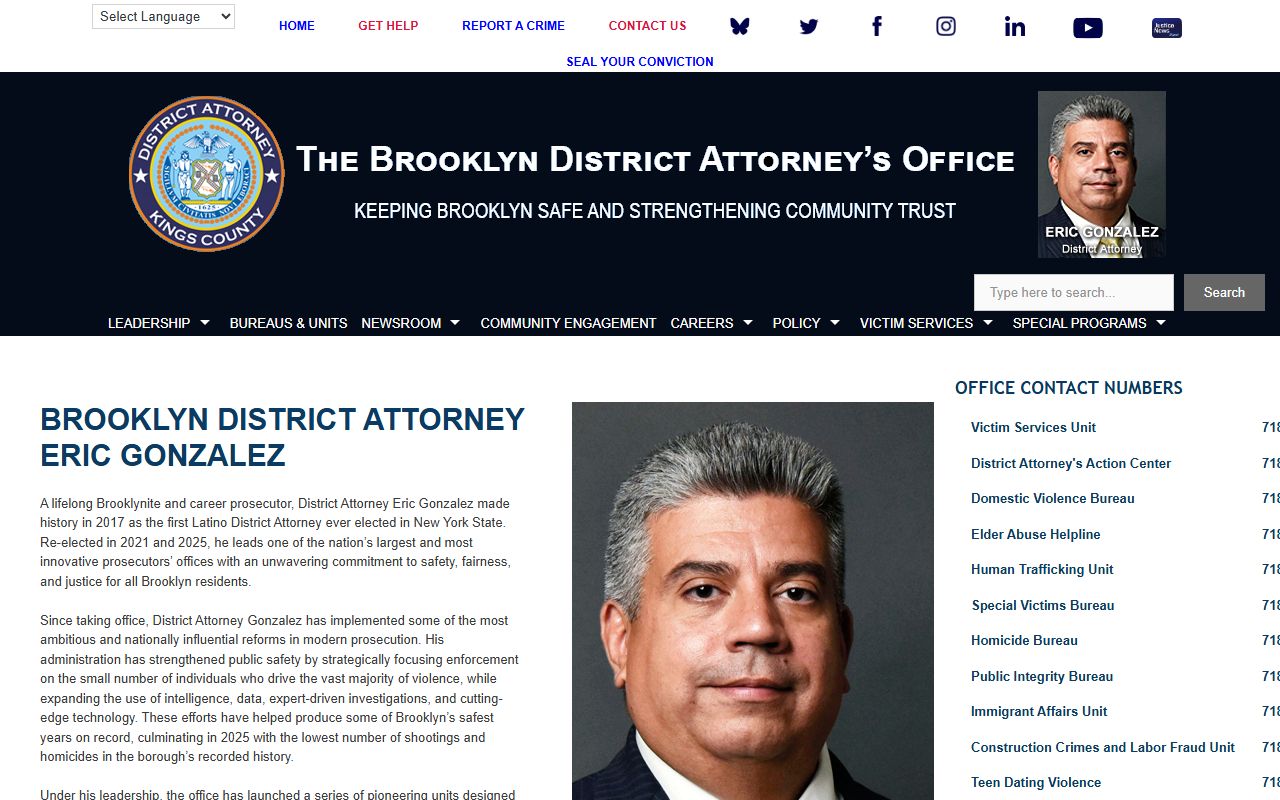
The DA page is useful when an arrest is fresh and the question is which bureau holds the file. Specialized bureaus handle homicide, gender-based violence, hate crimes, elder abuse, and human trafficking.
Data timing matters. NYC DOC has stated that 48 hours or more may pass between the arrest and the DOC system showing the person. If someone is given a Desk Appearance Ticket and sent home, DOC may never have a record of that person at all. The same is true for arraignment releases on recognizance or on posted bail. A blank DOC result does not always mean no arrest; it can mean no jail housing.
Arrest Record vs Criminal Court Record
People often blur the arrest record with the court record. They are not the same. An arrest record is created by police at the moment of arrest. It captures the charge as the officer wrote it, the location, the time, and the prints. A criminal court record is created by the court when the case is filed and grows with each docket entry. The arrest record may go away after a favorable termination. The court record may stay open longer and may include filings that the arrest report never had.
| Item | Arrest Record | Criminal Court Record |
|---|---|---|
| Source | NYPD, NYC DOC, DCJS | NYC Criminal Court or Kings County Supreme Court Criminal Term |
| What It Shows | Booking event, arrest charge, prints, photo, holding facility | Docket, indictment, motions, bail, plea, sentence, disposition |
| Where It Lives | Police file, DOC database, DCJS rap sheet | Court file at 320 Jay Street or 120 Schermerhorn Street |
| How to Get It | DOC public lookup; statewide history through DCJS process | WebCrims for live dates; court records page for filed cases |
For a deeper walk through the docket side, see the Kings County court records page and the court dockets page.
Charges vs Convictions in Kings County
An arrest charge is what the arresting officer thought the crime was at the scene. A filed charge is what the DA decides to bring after review. A conviction is the final finding by a court, by plea or by verdict. Each step can shrink or change the picture. A felony arrest can end up filed as a misdemeanor. A misdemeanor arrest can end up dismissed. Many Kings County arrests never become convictions at all.
| Stage | Who Decides | Public Effect |
|---|---|---|
| Arrest charge | Arresting officer at the scene | Appears on arrest paperwork; may not match later filings |
| Filed charge | Brooklyn DA after review | Appears on the criminal court docket and complaint |
| Indictment | Grand jury in Kings County | Felony case moves to Supreme Court Criminal Term |
| Plea or verdict | Defendant and court, or jury | Sets the conviction or acquittal of record |
| Sentence | Trial judge | Recorded with disposition; may trigger DOC or DOCCS custody |
Background-check tools that show only an arrest, without showing the disposition, are misleading. The truthful record is the certificate of disposition issued by the court that closed the case. For Kings County felony cases, that comes from the Criminal Term Records Room.
Mugshots and What Is Actually Public
Mugshots in New York are not a free public file the way some states treat them. The official NYC DOC person-in-custody lookup does not promise to display a booking photo. NYPD does not run a public mugshot gallery. Most images on third-party mugshot sites come from scraping or from press releases tied to a small number of cases. The fact that a photo lives online does not mean the case is open or that the person was ever convicted.
Warning. Third-party mugshot sites often charge fees to remove old photos and rarely show the case outcome. They are not the official record. For any decision that matters, pull the court file or the certificate of disposition from the issuing court, not a private site.
Public data on a Kings County arrest is also affected by Desk Appearance Tickets. A person released on a DAT may never appear in NYC DOC data at all, because DOC only houses people committed by the court. That gap is normal. It is not proof that the arrest did not happen.
Sealed and Expunged Records
New York mostly seals records rather than destroying them. Sealing hides the record from common public view, but the file still exists for limited official use. Expungement, in the full erase sense, is rare in this state. Three statutes drive sealing for arrest and conviction records in Kings County.
CPL § 160.50 seals arrest and prosecution records after a favorable termination, such as a dismissal or acquittal. CPL § 160.55 seals most violations and traffic infractions on conviction, with a few named exceptions. CPL § 160.59 lets eligible people petition to seal certain older convictions ten years after sentence or release. The filing fee in New York City courts is $10. A judge reviews each petition on its facts.
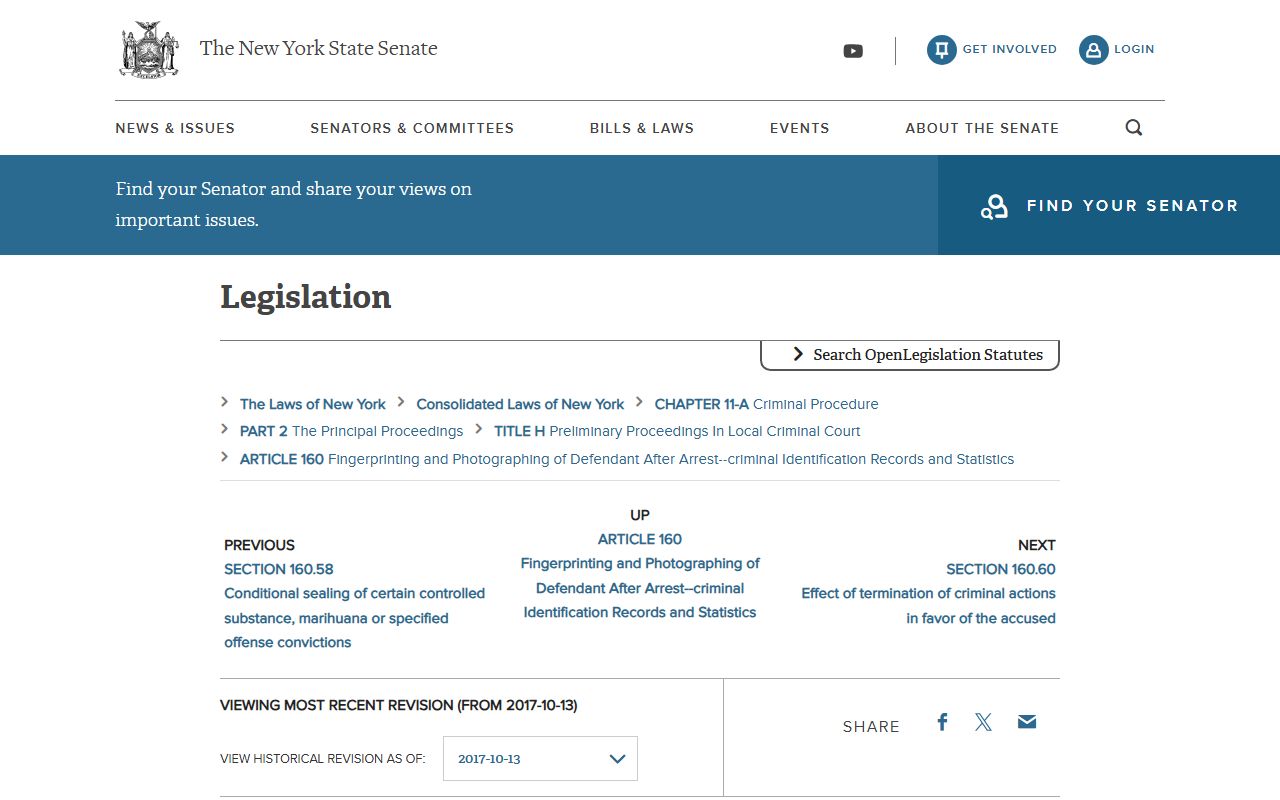
The statute text sets out who qualifies, what the waiting period means, and which crimes are off the table for sealing. The court rules and the application packet must be followed exactly, or the petition will be returned.
The image below links to the official CourtHelp page on CPL § 160.55, which explains automatic sealing for violations and traffic infractions in plain language.
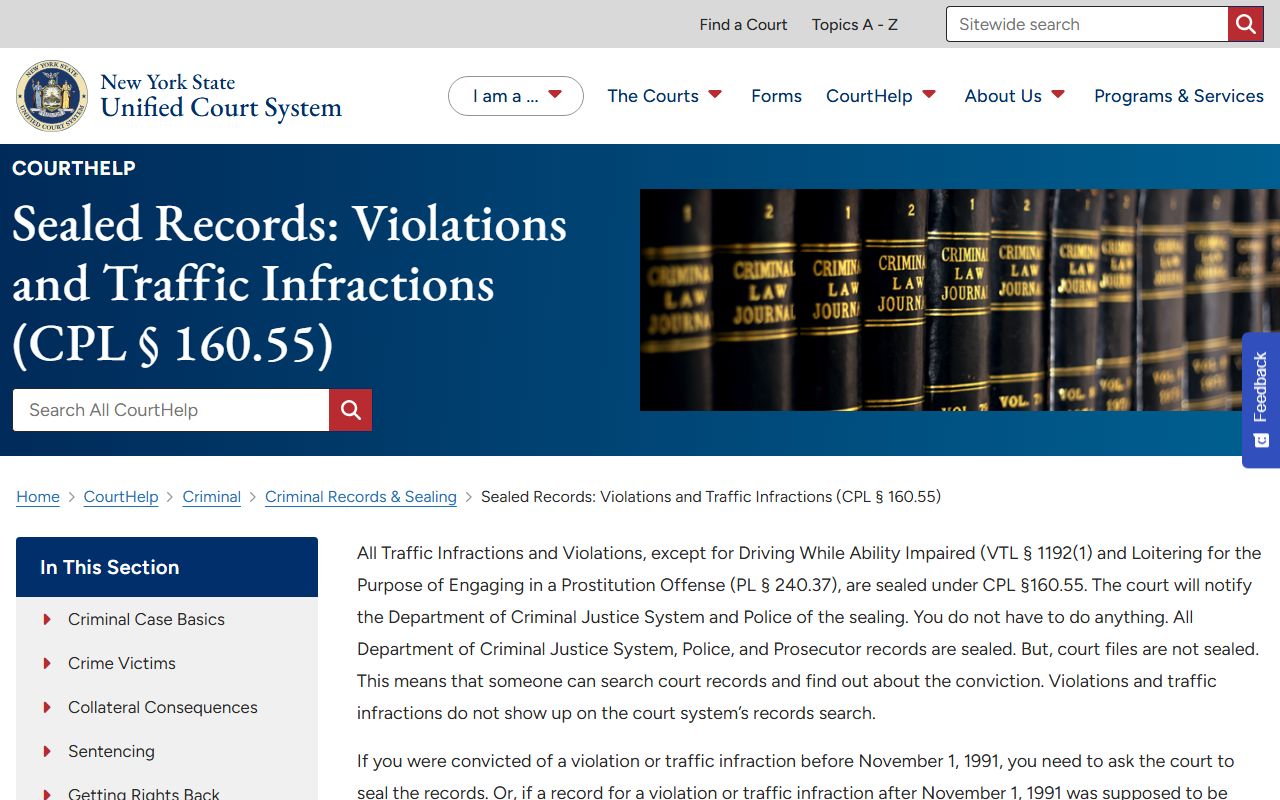
One catch: DWAI under VTL § 1192(1) and the loitering-for-prostitution offense under Penal Law § 240.37 are carved out of automatic sealing. Those keep showing up on records even after a conviction that looks minor on paper.
Brooklyn District Attorney's Office
The Brooklyn DA decides which Kings County arrests turn into criminal cases. The office is led by District Attorney Eric Gonzalez. He was first elected in 2017 and re-elected in 2021 and 2025. The office runs specialized bureaus that handle homicide, gender-based violence, hate crimes, elder abuse, human trafficking, and others. It also runs a Conviction Review Unit and a Post-Conviction Justice Bureau that look at older cases. The office is one of the largest prosecutors' offices in the country.
Brooklyn District Attorney's Office
350 Jay Street
Brooklyn, NY 11201
718-250-2340
Victim Services: 718-250-3820
Domestic Violence: 718-250-3300
Criminal Term Records Room
320 Jay Street
Brooklyn, NY 11201
347-296-1076
Mon-Fri 9 AM-5 PM
For victims and families tracking an arrest through the case, the DA's Victim Services Unit at 718-250-3820 is the right first call. Brooklyn Family Justice is reached at 718-250-5111. The Action Center main line at 718-250-2340 routes general questions.
Background Check Considerations
A Kings County arrest record is not the same as a clean criminal background check. The official statewide criminal history lives with the New York State Division of Criminal Justice Services. The public does not pull the rap sheet directly. Employers, landlords, and licensing boards use fingerprint-based DCJS processes to access it. The DCJS sex offender registry search is a separate public tool that lists Level 2 and Level 3 offenders.
For a person's own arrest history, the right approach is to gather: the arrest paperwork, the certificate of disposition for each case, any sealing order, and any plea papers. Those documents tell a clean story even when an aggregator site shows only the arrest. Fair Credit Reporting Act rules also limit how old arrests can be used by consumer reporting agencies, which keeps some old data out of background-check reports even when it still exists.