
Surrogate's Court Is the Probate Court in Kings County
Probate records in Kings County come from the Surrogate's Court. This is the court that handles the affairs of people who have died. The court's own page says it hears cases about wills and the proper way to manage or divide a dead person's assets and debts. It also settles disputes among heirs. New York does not use a separate "probate court" name. The work runs through Surrogate's Court instead, so a Brooklyn estate file lives there and not in the Supreme Court or the County Clerk's record room.
The court does more than wills. It opens estate files when there is no will. It holds wills people leave for safekeeping while they are still alive. It oversees the guardianship of property for minors and for some adults. And it is authorized to handle adoptions. Two Surrogates sit in Kings County, the Hon. Rosemarie Montalbano and the Hon. Bernard J. Graham, with Chief Clerk Lisa Mathis running the office. Most of what the court files is open to the public, though some records stay sealed by law.
Probate Terms Defined
Estate files use words that trip up a lot of people. A quick glossary helps before you read a Kings County probate record. The terms below show up on petitions, decrees, and the letters the court signs once it approves a filing.
- Testator
- The person who made the will. After death, the will is offered to the Surrogate's Court for probate.
- Executor
- The person named in the will to carry it out. The court grants letters testamentary so the executor can act.
- Administrator
- The person the court appoints to settle an estate when there is no will. The court issues letters of administration to this person.
- Intestate
- Dying without a will. State law then sets who inherits, and the estate is opened as an administration, not a probate.
- Letters testamentary
- The court order that gives an executor legal power to gather assets, pay debts, and pass on what is left.
How to Search Kings County Surrogate's Court Records
WebSurrogate is the key portal for estate files. It is free. It provides information on estate proceedings and other filings in New York Surrogate's Courts, and it lets you search files, pull documents, and view public historical records. One thing matters most. The system links to document images only for filings made on or after February 19, 2014. Older files may show an index entry, but the scanned pages will not be online. For those, you contact the court at 2 Johnson Street.
The picture below links to the official Kings Surrogate's Court e-filing protocol, which sets out how files are opened and searched in Brooklyn estate matters.
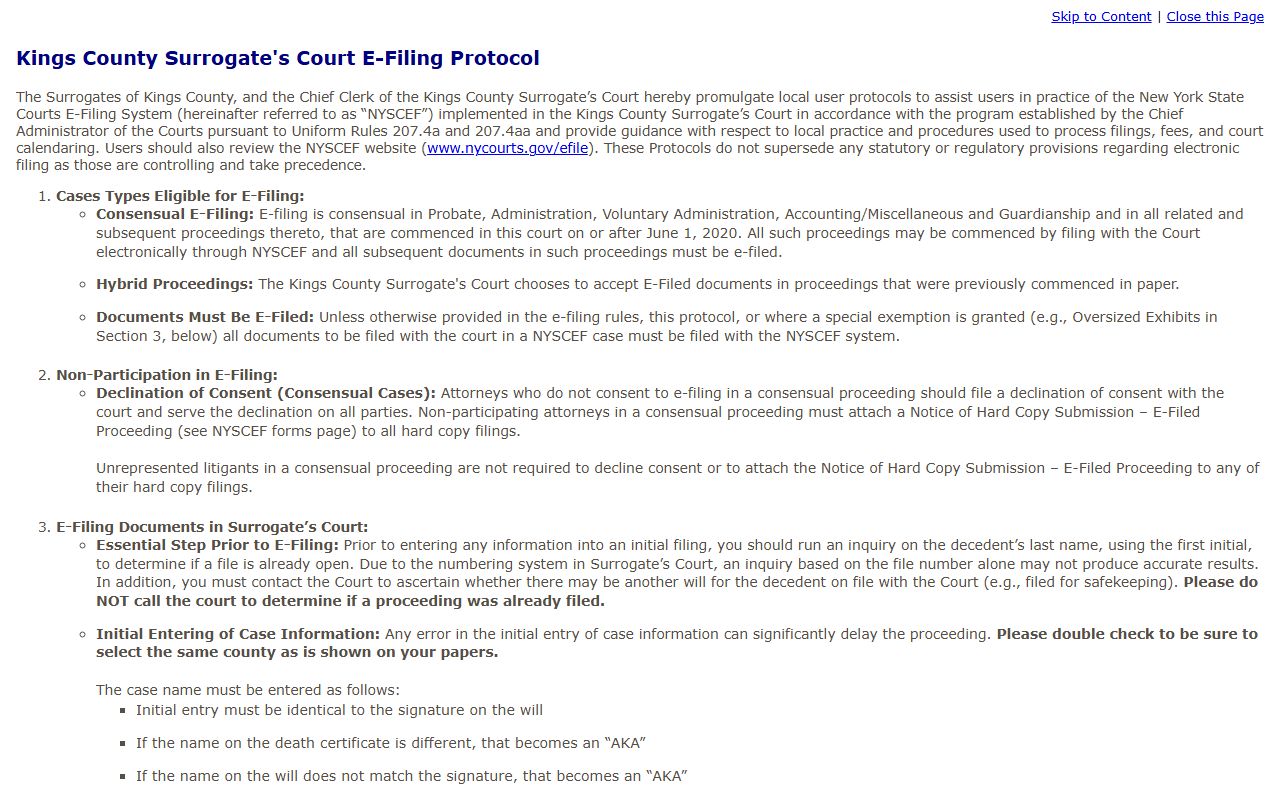
The protocol tells filers to run a name inquiry before opening a new file, which is the same first step a record searcher takes.
- Open WebSurrogate. Choose Name Search to find a file by party name, then narrow by date of death.
- If you have a file number, use File Search instead. For older matters, try Old Index Search or browse the Index Book Pages.
- Open the file to view the proceeding type, parties, and any document images filed on or after February 19, 2014.
- For a will held for safekeeping, use Will Search by testator name. Those records are not open for public view.
- For a certified copy or an older paper file, contact the court at 2 Johnson Street, Brooklyn.
Probate Versus Administration
The path an estate takes depends on one thing. Did the person leave a will? If yes, the case is a probate. The named executor offers the will, and the court reviews it before signing letters testamentary. If there is no will, the estate is opened as an administration. The court then appoints an administrator and issues letters of administration. State law sets the order of who inherits in an administration. Small estates may qualify for a simpler voluntary administration track.
The case name on a Kings County estate file must be entered to match the will signature. If the death certificate spells the name in a different way, that other spelling becomes an AKA on the file. The same is true if the name in the body of the will does not match the signature. This is why a name search may turn up several spellings tied to one estate. Knowing both the will path and the no-will path helps a searcher read the file type correctly.
Kings County Surrogate's Court Contact
There is one Surrogate's Court for Kings County. It sits a short walk from the other downtown Brooklyn courthouses. Use the contact card below for in-person visits, paper file requests, and questions on older estate records that are not online. Note the Wednesday half-day and the lunch closing, since the office keeps a split schedule.
Kings County Surrogate's Court
2 Johnson Street
Brooklyn, NY 11201
347-404-9700
Mon, Tue, Thu, Fri 9 AM-4:45 PM; Wed 9 AM-noon; closed 1 PM-2 PM
Note: Each unit has its own line. Probate is 347-404-9670, Administration 347-404-9690, Guardianship 347-404-9664, and the Cashier 347-404-9730.
E-Filing, Wills, and Death Certificate Rules
Kings County uses NYSCEF for Surrogate's Court e-filing under a county protocol. E-filing is consensual in probate, administration, voluntary administration, accounting, guardianship, and related matters started on or after June 1, 2020. The court also accepts e-filed papers in hybrid cases first opened on paper. Before any initial filing, the protocol tells users to run an inquiry on the decedent's last name to see if a file is already open. Do not call the court to check; run the search yourself.
Two original-document rules matter most. When a will is filed, the filer scans the original without unstapling it, then files the original paper will with the court within two business days. A death certificate works the same way. You e-file the copy and bring or mail the original within two business days. Proposed citations go through NYSCEF only; the court completes and uploads them. The same goes for decrees and orders, which the court signs and posts back to the file. The image below links to the Surrogate's Court Procedure Act, Article 25, which sets the rules for the will and the safekeeping deposit.
Article 25 covers how a will is admitted and how a deposited will is kept and released, which feeds the safekeeping search on WebSurrogate.
Surrogate's Court Filing Fees
Filing fees in Kings County Surrogate's Court are set by statute, not by the clerk. Most probate and administration fees scale with the size of the estate under the Surrogate's Court Procedure Act. The table below lists common items. Confirm the current amount with the court, since the statute sets several brackets by estate value.
| Item | Amount |
|---|---|
| Estate under $10,000 | $45 |
| Estate $10,000 to under $20,000 | $75 |
| Estate $20,000 to under $50,000 | $215 |
| Estate $50,000 to under $100,000 | $280 |
| Estate $100,000 to under $250,000 | $420 |
| Estate $250,000 to under $500,000 | $625 |
| Estate $500,000 and over | $1,250 |
| Certified copy of letters or decree | $6 per copy |
Fees are paid by credit card through NYSCEF or at the court cashier. There is no NYSCEF system fee. If you pay at the court, the documents are not filed until payment clears in full. The fee brackets come from the Surrogate's Court Procedure Act section 2402, which ties the probate and administration filing fee to the value of the estate.
What Kings County Surrogate's Court Records Show
An estate file holds more than the will. It tracks the whole life of the case. A typical Kings County probate record shows the decedent name and any AKA, the date of death, the proceeding type, the petitioner, and the named fiduciary. It carries the petition, the citation served on interested parties, and the family tree or heirship proof. Once the court approves, the file holds the decree and the letters that empower the executor or administrator.
As the estate is settled, more papers join the file. An inventory of assets, an accounting of money in and out, creditor claims, and the final plan of distribution all land in the record. For e-filed cases on or after February 19, 2014, you can open these as scanned images on WebSurrogate. For older files, the index entry shows the file exists, but you go to the court to read the paper. Adoption files run through this court too, and those stay sealed.
Restricted Surrogate's Court Records
Not every Surrogate's Court record is open. WebSurrogate applies the restrictions in Uniform Rule 207.64 and blocks access to restricted files and documents. The system does not redact for you. Parties must strip out confidential personal information themselves before filing, since the portal will not hide a Social Security number or an account number on its own. Wills filed for safekeeping are searchable by testator name, but the document itself is not open to public view while the person is alive.
Adoption records carry the strongest seal. Under Domestic Relations Law section 114, adoption records and papers are sealed and withheld from inspection. Access needs a court order or a specific statutory step. The image below links to that statute. To submit a document for sealing under the Kings protocol, a party files a hard copy with a Notice of Hard Copy Submission. If the court grants sealing, the Surrogate Clerk files it as directed. If the court denies the request, the party then files it electronically.
The statute text spells out the seal on adoption files and the narrow ways a person can ask a court to open them.